
Genesis 1:14-25
Not long ago I officiated an outdoor wedding for two of my church members. I arrived long before the ceremony and spent some time looking over the venue. Off to the left were rows of empty chairs for the ceremony itself, and off to the right were chairs and empty tables for the reception. It was clear that a great deal of planning and work had gone into the preparation; the spaces were defined. All that was lacking was the people: the guests, the caterer, and of course, the bride and groom. In my previous article, we looked at the defining of spaces, the realms or kingdoms, by decrees of creation and separation. Today, we see God fill those spaces with appropriate populations of gargantuan planets and microscopic life. Welcome to days 4-6.
Revisiting Foundations
Before we begin the narrative of God populating His creation with creatures, it’s good for us to revisit some of the foundational principles we’ve learned along the way. Gen. 1 is meticulously written by Moses to convey beauty and truth. In the original Hebrew, it’s almost Haiku-like. Sentences are structured with word-groups of 3’s and 7’s and so on. More importantly, God is conveying crucial truths through Moses, but it’s important that we understand what God is telling us and what God is not focused on, so that we don’t distort the message by stretching it like an undersized t-shirt.
Who is creating? God. It’s not YHWH working with the angels; it’s not multiple warring deities. It’s just God. Everything that isn’t the triune God is God’s creation.
When is God creating? In the beginning. Nothing precedes God, and all of creation began when God created it. The focus here isn’t as much on how long it took God, but more so on God’s creation of time itself.
How is God creating? By the authority and power of His word. He creates out of nothing and forms and separates things He has already made by decree.
Why is God creating? To reveal His own glory. Rom. 1:20, “For his invisible attributes, namely, his eternal power and divine nature, have been clearly perceived, ever since the creation of the world, in the things that have been made. So they are without excuse.” Last time, we saw God’s power in creation as the emphasis, but now the focus is expanded to include God’s wisdom. In creating the realms, God displays His glory, but in filling them with creatures, He displays His wisdom. It is unimaginable power to make and form matter, but in the designs necessary for living things, it is incomprehensible wisdom.
For any questions beyond these, we need to remember that God’s Word is God speaking truth to man in condescension. God is revealing Himself in His actions to an ancient people, so He uses terms that they (and we) can understand. Moses’ original audience had no telescopes, microscopes, or space shuttles, so it shouldn’t surprise us that there’s no distinction between sky and outer space or mention of amoebas and molecules. As Calvin put it, “Moses wrote in a popular style things which, without instruction, all ordinary persons, endued with common sense, are able to understand…”
God is also guiding Moses to write this account to show His creation of a vocabulary and metaphors along with the setting of redemptive history. If, as Shakespeare claims, all the world is a stage, today we are meeting the minor cast. And as we come to days 4-6, we see how God is using a framework. Day 1 corresponds to day 4, 2 to 5, and 3 to 6.
Day 4: Celestial Bodies
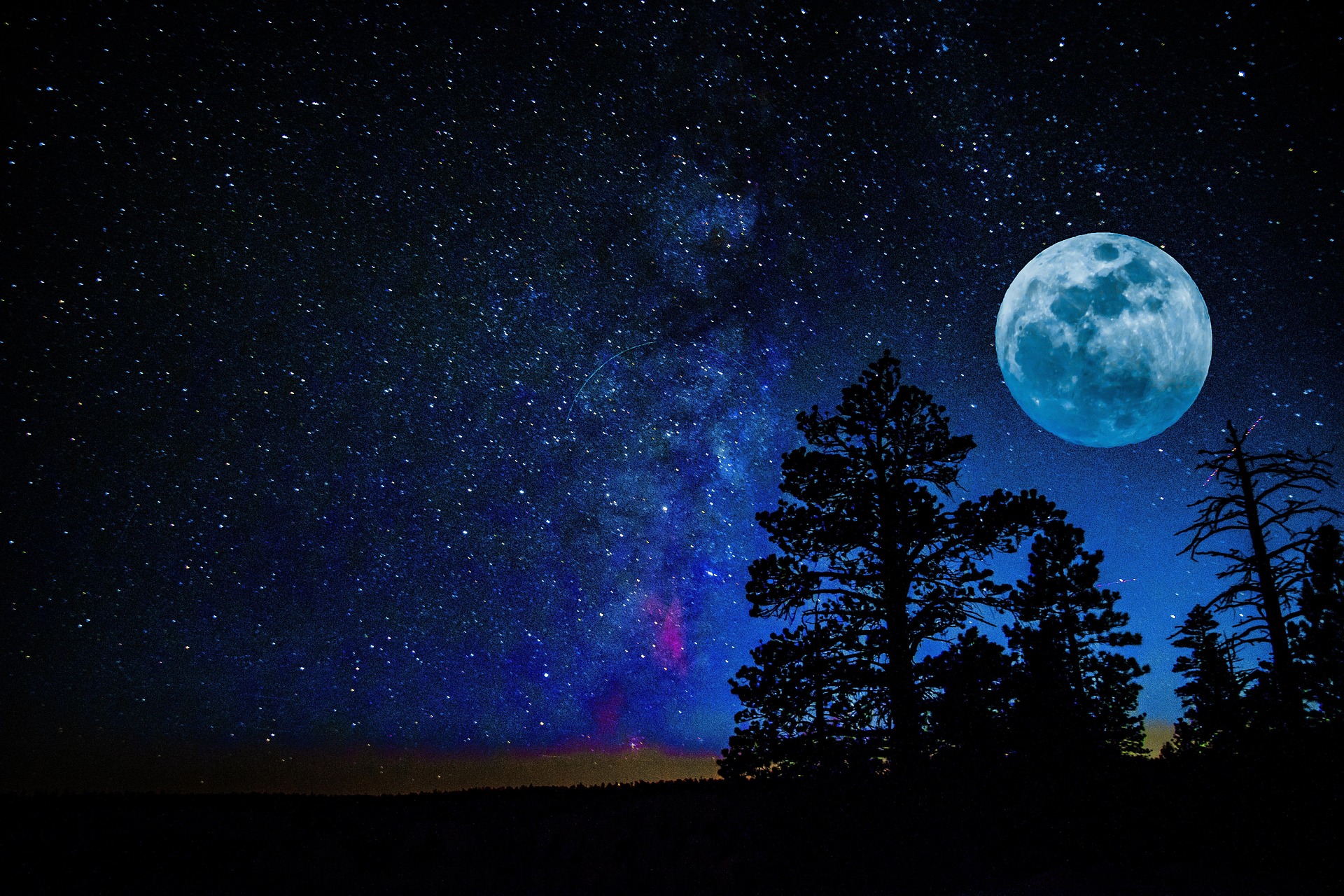
Corresponding to the creation of light, now we see God create the sun, moon, and stars. It’s unclear what the original light source was. John Gill cites a Jewish and Christian tradition that “…the body of fire and light produced on the first day was now distributed and formed into several luminous bodies of sun, moon, and stars, for these were ‘from light…’” because the word here for lights can be translated as such.
We are seeing the familiar sight of the celestial bodies that generate light and reflect it. Matthew Henry writes, “He made the stars also, which are here spoken of as they appear to vulgar eyes, without distinguishing between the planets and the fixed stars, or accounting for their number, nature, place, magnitude, motions, or influences; for the scriptures were written, not to gratify our curiosity and make us astronomers, but to lead us to God, and make us saints.” God creates them with specific purposes in mind.
First, we are told they are signs. This isn’t Bible astrology where the stars predict that you’ll wake up tomorrow, do a bunch of stuff, and go back to sleep. We are cautioned in Jer.. 10:2, “Thus says the Lord: ‘Learn not the way of the nations, nor be dismayed at the signs of the heavens because the nations are dismayed at them.’” Yet the stars serve as signs in a variety of ways.
Psa. 19:3-6, “There is no speech, nor are there words, whose voice is not heard. Their voice goes out through all the earth, and their words to the end of the world. In them he has set a tent for the sun, which comes out like a bridegroom leaving his chamber, and, like a strong man, runs its course with joy. Its rising is from the end of the heavens, and its circuit to the end of them, and there is nothing hidden from its heat.” This is interpreted for us in Rom. 10:17-18, “So faith comes from hearing, and hearing through the word of Christ. But I ask, have they not heard? Indeed they have, for ‘Their voice has gone out to all the earth, and their words to the ends of the world.’”
In the story of the wise men, Matt. 2:9 records, “After listening to the king, they went on their way. And behold, the star that they had seen when it rose went before them until it came to rest over the place where the child was.”
In Luke 21:25-28, Jesus taught, “And there will be signs in sun and moon and stars, and on the earth distress of nations in perplexity because of the roaring of the sea and the waves, people fainting with fear and with foreboding of what is coming on the world. For the powers of the heavens will be shaken. And then they will see the Son of Man coming in a cloud with power and great glory. Now when these things begin to take place, straighten up and raise your heads, because your redemption is drawing near.”
Even their darkness-producing absence is used by God as a sign of His wrath. The description of the day of judgment in Zech. 14:6-7: “On that day there shall be no light, cold, or frost. And there shall be a unique day, which is known to the Lord, neither day nor night, but at evening time there shall be light.” In Mark 15:33, we see God’s wrath poured out on Christ with a visible representation. “And when the sixth hour had come, there was darkness over the whole land until the ninth hour.”
Derek Kidner writes, “As signs they will speak for God, not for fate, for they rule only as lightbearers, not as powers. In these few simple sentences the lie is given to a superstition as old as Babylon and as modern as a newspaper horoscope.” And Arthur W. Pink points out that there is a parallel here to Christ and the church. The church is identified with the moon in Rev. 12:1 and borrows its light from Jesus. In this way too, the greater and lesser lights are signs. And as we saw in the last article, they serve as metaphors for the light of God, Christ, and truth.
John 9:4, “We must work the works of him who sent me while it is day; night is coming, when no one can work.” Then in John 11:9-10, “Jesus answered, ‘Are there not twelve hours in the day? If anyone walks in the day, he does not stumble, because he sees the light of this world. But if anyone walks in the night, he stumbles, because the light is not in him.’”
And when the fullness of history has come, these lights will be done away with. Isa. 60:19-20, “The sun shall be no more your light by day, nor for brightness shall the moon give you light; but the Lord will be your everlasting light, and your God will be your glory. Your sun shall no more go down, nor your moon withdraw itself; for the Lord will be your everlasting light, and your days of mourning shall be ended.” So also in Rev. 22:5, “And night will be no more. They will need no light of lamp or sun, for the Lord God will be their light, and they will reign forever and ever.”
God created them for seasons, or more literally, appointed times. The tilt of the earth and position of the sun provides wet and dry seasons, summers and winters. Eccl. 3:1-2, “For everything there is a season, and a time for every matter under heaven: a time to be born, and a time to die; a time to plant, and a time to pluck up what is planted.” God would use these seasons as occasions for festivals that prophesied of Jesus. He even created spring, a time of new life, when He would rise from the dead as the Christ. He used sun, moon, and stars to mark the passage of time in days and years until the coming of the Messiah and now to build anticipation of His return.
As with light in day one, He uses them to give light upon the earth. As Matthew Henry says, “The lights of heaven do not shine for themselves, nor for the world of spirits above, who need them not; but they shine for us, for our pleasure and advantage. Lord, what is man, that he should be thus regarded!” He is referencing Ps. 8:3-4, “When I look at your heavens, the work of your fingers, the moon and the stars, which you have set in place, what is man that you are mindful of him, and the son of man that you care for him?”
Luther writes, “And so here, there gleams, a spark of eternal life, in that the human being busies himself by nature with this knowledge of nature. This concern indicates that men were not created to live permanently in this lowest part of the universe, but to take possession of heaven, because in this life, they admire, and busy themselves with the study of, and the concern about, heavenly things.”
Finally, He appoints these celestial lights to rule over the day and night, separating light from darkness. Ps. 136:9, “the moon and stars to rule over the night, for his steadfast love endures forever.” Admittedly, this is an unintelligent government, redundant as that may sound. But there’s a hierarchy being subtly established. God isn’t just filling space; He is creating moving bodies to reign over realms. As other commentators have pointed out: the fish, birds, and land animals will reign over their realms in a way. Think of how we call the lion the king of the jungle.
In the next article, we’ll be looking at how God forms man in His image to have dominion over it all, crowned over creation yet under God. This dominion is now at least partly lost in the fall, though.
Again, God declares it good. This is work wisely done, the earth in proximity to the sun, neither too far where we freeze or too close where we burn up, what is known as the goldilocks zone. To paraphrase the medieval theologian called Venerable Bede, part of why God has declared his judgment of these things as good is because we make for poor judges in general. We might complain from our perspective about the heat of the sun, but it is only God’s opinion that truly matters.
These lights of heaven provided yet more metaphors from scratch, namely the angels who are often described in terms of stars. To be clear, Jupiter and Mars are not gods of realms and the North Star is not an actual angel, but they do serve as reminders of a grander spiritual realm. The heavens declare the glory of God in more senses than one. Gill tells us they were made by God “not to rule men, though the heathens have worshiped it under the names of Molech and Baal, which signify king and Lord, as if it was their Lord and king to whom they were to pay homage; but to rule the day, to preside over it, to make it and give light in it, and continue it to its proper length…”
But neither the stars or the angels are to be worshipped or prayed to. Greidanus writes, “Notice that in verse 16 the author deliberately avoids the names of sun (šhemeš) and moon (yārēaḥ), the names of the pagan gods…” It is shameful to worship creatures and creation when their purpose is to direct our worship to God. Rom. 1:22-25, “Claiming to be wise, they became fools, and exchanged the glory of the immortal God for images resembling mortal man and birds and animals and creeping things. Therefore God gave them up in the lusts of their hearts to impurity, to the dishonoring of their bodies among themselves, because they exchanged the truth about God for a lie and worshiped and served the creature rather than the Creator, who is blessed forever! Amen.”
Day 5: Birds and Fish
By day 5, the pattern feels familiar. By divine decree, the realms of water and sky from day 2 are filled with creatures. What incredible beauty and design! Organelles and cells, organs and systems in semi-intelligent creatures that live, move, and breathe. Women and men, marine biologists and ornithologists have spent their whole lives studying subgroups of these, but God created them in a day.
It is fascinating that the great sea creatures of v. 21 can be translated as monsters, possibly an allusion to Leviathan, but it is paired with “swarms” to give us that sense of great and small. From the megalodon to algae, they are made. Ps. 104:25-26, “Here is the sea, great and wide, which teems with creatures innumerable, living things both small and great. There go the ships, and Leviathan, which you formed to play in it.”
The birds that draw our eyes and minds heavenward display God’s design of wisdom. We would never have built flying machines without first copying what God did effortlessly. God made them fruitful to fill the spaces of sky and sea after their own kinds.
And God is still creating vocabulary for us. In the seas we see the first generation of active life, and today we see the waters of baptism as the symbol of the believer’s new life in Christ. But these are also minor characters for the history of redemption. Here are fish to be multiplied in Christ’s hands to feed the multitude in Matt. 14:15-21, the great fish to swallow Jonah, the small fish for Peter to pay a tax in Matt. 17:24-27. Even the turtledoves are here, the sacrifice of the poor that pointed to Jesus. There is the form of the dove which the Holy Spirit will take on at Christ’s baptism to be seen.
Day 6: Land Creatures
On the first part of day 6, God created the land animals. Earthworms and elephants, ants and alligators, God caused them all to come forth from the land. He makes the animate from the inanimate to reproduce after their kind. Ps. 104:24, “O Lord, how manifold are your works! In wisdom have you made them all; the earth is full of your creatures.”
Many years ago, I had the opportunity to watch one of the Venetian Moreno glass blowers in person. He took a glob of molten glass and almost idly rolled it and pulled at it with his tongs. As I watched, a magnificent glass horse took shape. When he was done and had set the horse on the table, he smashed it. All of us watching gave a collective gasp, but he simply swept the shards up and tossed them back into the oven. What struck me most was how this creative act was so effortless to him with his skill. Yet God formed with less effort actual horses with beating hearts!
Again, we are seeing God’s power and wisdom on display, but there are even thinly veiled words of God’s revelation and instruction. Here is the ant to teach the sluggard about hard work, Prov. 6:6.
More importantly, God is forming metaphors of Christ. Our Savior is the lion of Judah we trace from Gen. 49:8-12, to Hos. 5:14, to Rev. 5:5. To borrow from C.S. Lewis, He is not safe, but He is good.
He is also the lamb slain from the foundation of the world, the sacrifice to atone for sinners. We trace that image from creation to Passover and finally to Rev. 5:6-13, “And between the throne and the four living creatures and among the elders I saw a Lamb standing, as though it had been slain, with seven horns and with seven eyes, which are the seven spirits of God sent out into all the earth. And he went and took the scroll from the right hand of him who was seated on the throne. And when he had taken the scroll, the four living creatures and the twenty-four elders fell down before the Lamb, each holding a harp, and golden bowls full of incense, which are the prayers of the saints. And they sang a new song, saying, ‘Worthy are you to take the scroll and to open its seals, for you were slain, and by your blood you ransomed people for God from every tribe and language and people and nation, and you have made them a kingdom and priests to our God, and they shall reign on the earth.’ Then I looked, and I heard around the throne and the living creatures and the elders the voice of many angels, numbering myriads of myriads and thousands of thousands, saying with a loud voice, ‘Worthy is the Lamb who was slain, to receive power and wealth and wisdom and might and honor and glory and blessing!’ And I heard every creature in heaven and on earth and under the earth and in the sea, and all that is in them, saying, ‘To him who sits on the throne and to the Lamb be blessing and honor and glory and might forever and ever!’”
Countless passes of the earth around that greater light later, God would enter into this creation He once declared good that was defiled by man’s sin. He would eat bread and fish of His own creation to grow in stature and to live a life of perfect obedience to the Father in our place. He would suffer the punishment for our sins as that once-for-all sacrifice and rise again three days later. We are great sinners, but He is a great Savior.

Chris J. Marley is the pastor of Miller Valley Baptist Church in Prescott, AZ. Chris has a BA in Theatre, an MDiv from Westminster Seminary California, and a certificate from the Institute of Reformed Baptist Studies. He is the author of Scarlet and White and Cow and Cog.