
Genesis 1:26-31
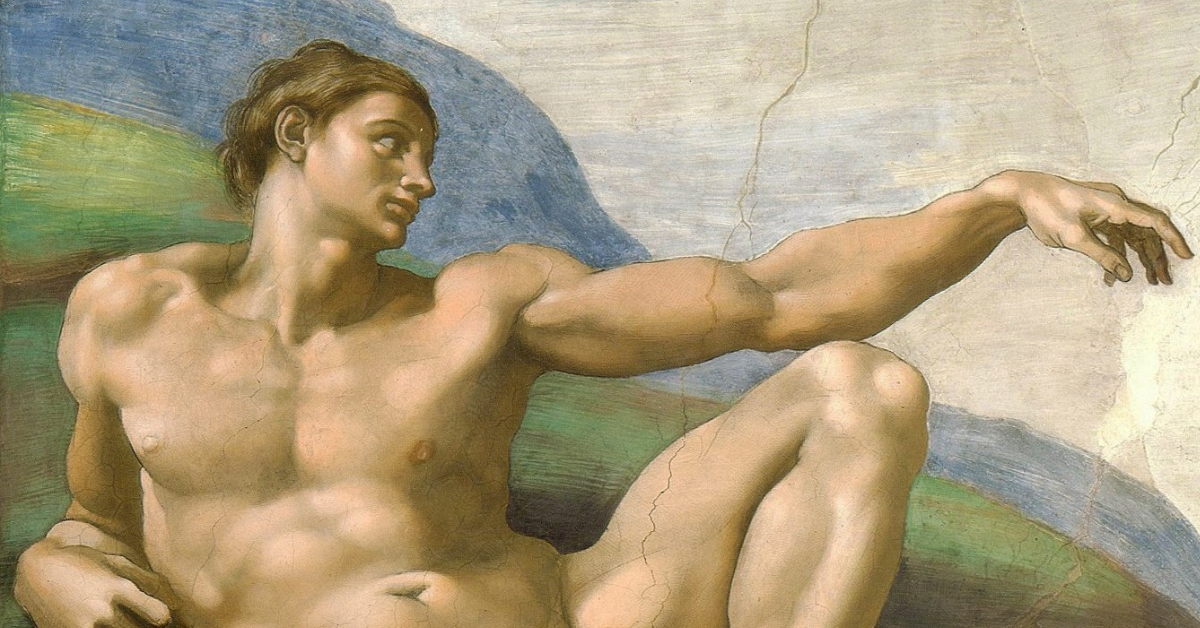
A few years back, a well-meaning, elderly woman in Borja, Spain noticed that a famous fresco in her church was beginning to fall apart. Elias Martinez’ painting Ecce Homo which is Latin for “Behold, man” was flaking and faded. So, she took a stab at restoring it to a disastrous result. Looking now like a horrifying mix of Munch’s The Scream and a monkey, the botched restoration has actually become more famous than the original. Today, we come to man’s creation in Gen. 1, where God speaks of creating man in His own image. But we must look at this in light of the way in which it has become a broken portrait, and what is necessary for it to be properly restored.
Buildup
We have been working through the Gen. 1 record of creation in 6 days. God created the heavens and the earth, separating realms of light, dark, sky, sea, and land, then filling those realms with creatures. Day 6 begins with the creation of land animals, but now we come to the creation of man. Most of Gen. 2 will be a deeper dive into this second part of day 6, so these verses only briefly introduce some of those ideas that we’ll be dealing with in subsequent articles. We’ll touch on these various ideas, but then I want to dive deeper into the unique aspects of this passage: the image of God and dominion.
It is no accident that we have man and animals made on the same day, but with clear lines of demarcation. Both dwell on the dry land which was formed in day 3. We’re meant to see both similarity and difference; we are meant to compare them.
It’s also placing Adam and Eve last in the sequence. Matthew Henry said, “…man was made last of all the creatures, that it might not be suspected that he had been, any way, a helper to God in the creation of the world: that question must be for ever humbling and mortifying to him, ‘Where wast thou, or any of thy kind, when I laid the foundations of the earth?’ Job 38:4.”
So, at the opening of our passage, we see God pause to think and contemplate. This is done for our sake. Man’s design is not substantially more intricate than the dolphin, giraffe, or bombardier beetle. Arguably, they would be more difficult to design. God spoke planets into existence without effort. God is pausing for dramatic effect, to show us His intentionality in creating man. Adam and Eve are the crowning jewels of creation. Lombard’s Sentences said that the rest of the animals are designated as footprints of God, but man alone is God’s image.
Even more than the previous verses, the creation of man shows us the Trinity in the plurals and singulars. The word for God is plural, but the verbs are singular, as we move through the previous days. Now we see God saying, “Let us make man in our image, after our likeness… So God created man in his image.”
As Bede, Calvin, and others point out, the “us” here must be the Father, Son, and Holy Spirit of the Triune God, because it is in God’s image that man is made. Attempts by Jewish and even some Christian scholars like Motyer to explain this as speaking to the earth or angels can’t really function. We are not made by angels, nor made in the image of angels, and angels aren’t God’s counselors. Rom 11:34-36, “‘For who has known the mind of the Lord, or who has been his counselor?’ ‘Or who has given a gift to him that he might be repaid?’ For from him and through him and to him are all things. To him be glory forever. Amen.”
Summaries
So, God created man and woman in His image. While Adam is made more directly as such, and Eve is, in a sense, bearing Adam’s image, v. 27 highlights for us that they are both still image bearers. As Motyer said, “…mankind, both male and female, is God’s representative on earth. Ancient oriental kings were often seen as bearing the image of their god, but Genesis affirms that every human being is made in God’s image.”
And in the midst of this, even through this, God is establishing the first marriage, male and female, heterosexual and monogamous. Mal 2:15, “Did he not make them one, with a portion of the Spirit in their union? And what was the one God seeking? Godly offspring. So guard yourselves in your spirit, and let none of you be faithless to the wife of your youth.”
In Mark 10:6-9, Jesus taught, “But from the beginning of creation, ‘God made them male and female.’ ‘Therefore a man shall leave his father and mother and hold fast to his wife, and the two shall become one flesh.’ So they are no longer two but one flesh. What therefore God has joined together, let not man separate.”
Drawing on the fact that God only made one man and one woman instead of multiples, Matthew Henry pointed out, “Our first father, Adam, was confined to one wife; and, if he had put her away, there was no other for him to marry, which plainly intimated that the bond of marriage was not to be dissolved at pleasure.”
God blesses them in their union, first in terms of their fruitfulness. They are designed to propagate through their exclusive intimacy and see new life produced from their love and connection. While that is good in itself, it is also a type of how Christ would come together with the church as the means of producing new spiritual life, saving sinners. More subtly, God is blessing them with real relationship to Him. He speaks to and with them, condescending to engage with His own creation.
He blesses them in their dominion over creation. Even with Adam as federal head over Eve, together they have dominion over creatures. But we’ll come back to this in a minute.
God blesses them in providence. Those plants from day three were for Adam and Eve to eat: fruits, veggies, grains, etc. Man wasn’t eating animals in the garden. Gill theorized that Adam may not have been initially allowed to eat the animals until they had properly propagated. It’s unclear whether we were meat eaters between the fall and the flood, but we certainly were after Noah. Gen 9:3, God said, “Every moving thing that lives shall be food for you. And as I gave you the green plants, I give you everything.” We do have animal sacrifices and wearing animal skins before the flood, so it’s possible they were eating them too. Luther observed that, while the animals were not included as food for man in Gen. 1, they aren’t forbidden either.
God blessed the animals with food as well. His care for all of His creation is a reminder to us of His active providence. Luke 12:24, “Consider the ravens: they neither sow nor reap, they have neither storehouse nor barn, and yet God feeds them. Of how much more value are you than the birds!” God didn’t make birds or cows or man until the support structure was already in place.
When it was all done, God declared it very good. This was creation unfallen and unbroken. In Rev 4:11, the elders proclaimed, “Worthy are you, our Lord and God, to receive glory and honor and power, for you created all things, and by your will they existed and were created.” As we look back on that very good creation, it is beneficial to cautiously theorize about what that may have looked like, as many a theologian has. We can only imagine how good fruits and vegetable tasted, how predators were then herbivores, and so on. We can’t have many certainties, but it helps us remember the reality of the past and grow hopeful for the future when God makes all things new.
Image
So, backing up to v. 26, what does it mean for humanity to be created in the image and likeness of God? Gen. 5:1-2, “This is the book of the generations of Adam. When God created man, he made him in the likeness of God. Male and female he created them, and he blessed them and named them Man when they were created.” 1 Cor. 11:7, “For a man ought not to cover his head, since he is the image and glory of God…”
First, we need to be clear that this image is not physiological. The omnipresent God uses anthropomorphisms of hands, nose, eyes, etcetera, but He doesn’t have an intrinsic material body. John 4:24 clearly tells us “God is spirit.”
As Bede said, “Not, therefore, in respect to the body but in respect to the intellect of the mind is humankind created in the image of God. Yet, we have in that very body a distinct characteristic that indicates this, because Adam was created upright in stature, so that by this fact he is reminded that he does not take after the earthly creatures, like the herds whose whole pleasure is from the earth. All of the other creatures go face down or crawl, as one of the poets (Ovid) most beautifully and truly said: “While other animals look face down at the earth, he gave to human beings an upturned face to see the lofty heaven; commanding them to look toward the skies and raise their faces to the stars.”’
But backing up in history from Bede a bit, one of the first major theories about this imago dei comes from the early church. Augustine (On the Trinity IX-XI) claimed that the image of God is that we have a memory, mind, and will. He saw this as a threefold inner-self God designed to reflect Trinity.
Luther, on the other hand, claims, “I am afraid that since the loss of this image through sin, we cannot understand it to any extent.” He even goes on to point out that if memory, will, and mind are the image of God, then we have to contend with the fact that Satan has all of these to a higher degree than we have them.
The 2nd London Baptist Confession summarizes the image of God in terms of knowledge, righteousness, and holiness. Knowledge would include Augustine’s ideas of memory and mind, with that capacity to consider one’s place in the universe and relation to God. Righteousness would include Augustine’s will, but goes further into ideas of morality. Adam had a sense of that which was good even before he knew its opposite of evil in a way the creatures still do not. Holiness speaks to man’s otherness, the way in which Adam was unique from the rest of creation as its ruler and in real relationship to God.
There are other things we might add as well, like creativity and artfulness, and the eternal soul. Ecc. 3:11, “(God) has made everything beautiful in its time. Also, he has put eternity into man’s heart, yet so that he cannot find out what God has done from the beginning to the end.”
But the main focus in this passage is dominion. Ps. 8:4-8, “what is man that you are mindful of him, and the son of man that you care for him? Yet you have made him a little lower than the heavenly beings and crowned him with glory and honor. You have given him dominion over the works of your hands; you have put all things under his feet, all sheep and oxen, and also the beasts of the field, the birds of the heavens, and the fish of the sea, whatever passes along the paths of the seas.”
Godfrey points out how God’s work since Gen. 1:2 has been to rule, subdue, and fill His creation, and now He is calling Adam to rule, subdue, and fill as the image bearer. Adam is to reflect God and glorify God in rule and reign over that creation while under God’s reign. Adam’s actions in this office of ruler over creation will not only affect his descendants but the universe around him as well.
But we also need to remember that whatever components are involved, the fact that we are image bearers means that we belong to Him. Matt 22:20-21, “And Jesus said to them, ‘Whose likeness and inscription is this?’ They said, ‘Caesar’s.’ Then he said to them, ‘Therefore render to Caesar the things that are Caesar’s, and to God the things that are God’s.’’
Distortion
If the image of God as Adam is a watercolor portrait not yet dried, Adam’s sin was the splash of water that distorted that image in every respect.
It is clear from the course of the Bible that the image of God is not completely lost. Gen. 9:6, “Whoever sheds the blood of man, by man shall his blood be shed, for God made man in his own image.” Jms. 3:9, “With (the tongue) we bless our Lord and Father, and with it we curse people who are made in the likeness of God.”
But knowledge, memory, mind, righteousness, will, and even holiness are distorted by our sin nature. Fallen man imitates the beasts in godlessness and promiscuity. Ps. 73:22, “I was brutish and ignorant; I was like a beast toward you.”
The dominion is warped as well. The cursed ground of thorns and thistles in Gen. 3:17-18 represents a creation in rebellion against man, from the lion that tears to the wasp that stings. Yet that dominion is not completely lost. Jms. 3:7, “For every kind of beast and bird, of reptile and sea creature, can be tamed and has been tamed by mankind.”
Augustine said, “For though he can be killed by many wild animals on account of the fragility of his body, he can be tamed by none, although he tames very many and nearly all of them. If, then, this state of man’s condemnation involves such power, what ought we to think of that reign of his, which is promised to him by the word of God, once he has been renewed and set free?”
Bede makes an interesting observation on God working through the creatures. “…as proof of the first creation, we read that the birds offer services to the saints who humbly serve God, and the mouths of beasts close and the poison of serpents is unable to harm them.”
Restoration
Rather than abandon His self-portrait of man, God took on the form of man as Jesus Christ. Col. 1:15, says of Jesus, “He is the image of the invisible God, the firstborn of all creation.” Heb. 1:3, “He is the radiance of the glory of God and the exact imprint of his nature…”
Heb. 2:6-10, “It has been testified somewhere, ‘What is man, that you are mindful of him, or the son of man, that you care for him? You made him for a little while lower than the angels; you have crowned him with glory and honor, putting everything in subjection under his feet.’ Now in putting everything in subjection to him, he left nothing outside his control. At present, we do not yet see everything in subjection to him. But we see him who for a little while was made lower than the angels, namely Jesus, crowned with glory and honor because of the suffering of death, so that by the grace of God he might taste death for everyone. For it was fitting that he, for whom and by whom all things exist, in bringing many sons to glory, should make the founder of their salvation perfect through suffering.”
F.F. Bruce once said, “It is because man in the creative order bears the image of his Creator that the Son of God could become incarnate as man and in his humanity display the glory of the invisible God.” As the second Adam, Christ was everything Adam should have been, and even took Adam’s curse upon Himself.
Again from Bede, “Adam, therefore, is created a new man from the earth according to God so that he may be made righteous, holy and true, submissive and humbly clinging to the grace of his Creator, who exists eternally and perfectly righteous, holy and true. Since he has corrupted this most unblemished purity of the image of God in himself by sinning and procreated a corrupt race of humankind from himself, the second Adam came, that is, the Lord and our Creator, born from a virgin, existing incorruptible and unchangeable according to the image of God, free from all fault and full of all grace and truth, so that he may restore his image and likeness in us by the example of his own character and gifts. He is the new man truly created according to God, as he took on the true substance of the flesh from Adam but to the extent that he brought nothing of defilement with it.”
Because of Christ, that image of God is being restored in us. It’s one of those already/not-yet things. When the Holy Spirit first acts upon us, calling us to God, we are regenerated and reborn in Christ’s image. That blessing of fruitfulness is spiritualized as we become a new creation, a renewed creation. Col. 3:9-10, “Do not lie to one another, seeing that you have put off the old self with its practices and have put on the new self, which is being renewed in knowledge after the image of its creator.” Eph. 4:24, “and to put on the new self, created after the likeness of God in true righteousness and holiness.”
Derek Kidner said, “The Bible makes man a unity: acting, thinking and feeling with his whole being. This living creature, then, and not some distillation from him, is an expression or transcription of the eternal, incorporeal creator in terms of temporal, bodily, creaturely existence – as one might attempt a transcription of, say, an epic into a sculpture, or a symphony into a sonnet. Likeness in this sense survived the fall, since it is structural. As long as we are human we are, by definition, in the image of God. But spiritual likeness – in a single word, love – can be present only where God and man are in fellowship; hence the fall destroyed it, and our redemption recreates and perfects it.”
As we go through the Christian life, that image of God, that image of Christ is clarified and refined. God restores His artwork in each saint by degrees in love. But it is in the New Heavens and New Earth that we will see the image of God restored in full.
All of us are a work in progress, but the real question is what are you becoming? Are you further distorting that image of God through your sin or are you being conformed to Christ? Has God called you and transformed you, drawing you towards heaven? Or has He left you to your own defilement that draws you toward destruction? The thing about a decaying piece of art… it can’t fix itself. Only God’s grace can make you fit for eternity with Him, cleanse you of the defilements of sin, and reconcile you to Himself. Only God can restore the portrait. Run to Him in repentance and faith that you might be saved for that creation remade.

Chris J. Marley is the pastor of Miller Valley Baptist Church in Prescott, AZ. Chris has a BA in Theatre, an MDiv from Westminster Seminary California, and a certificate from the Institute of Reformed Baptist Studies. He is the author of Scarlet and White and Cow and Cog.