
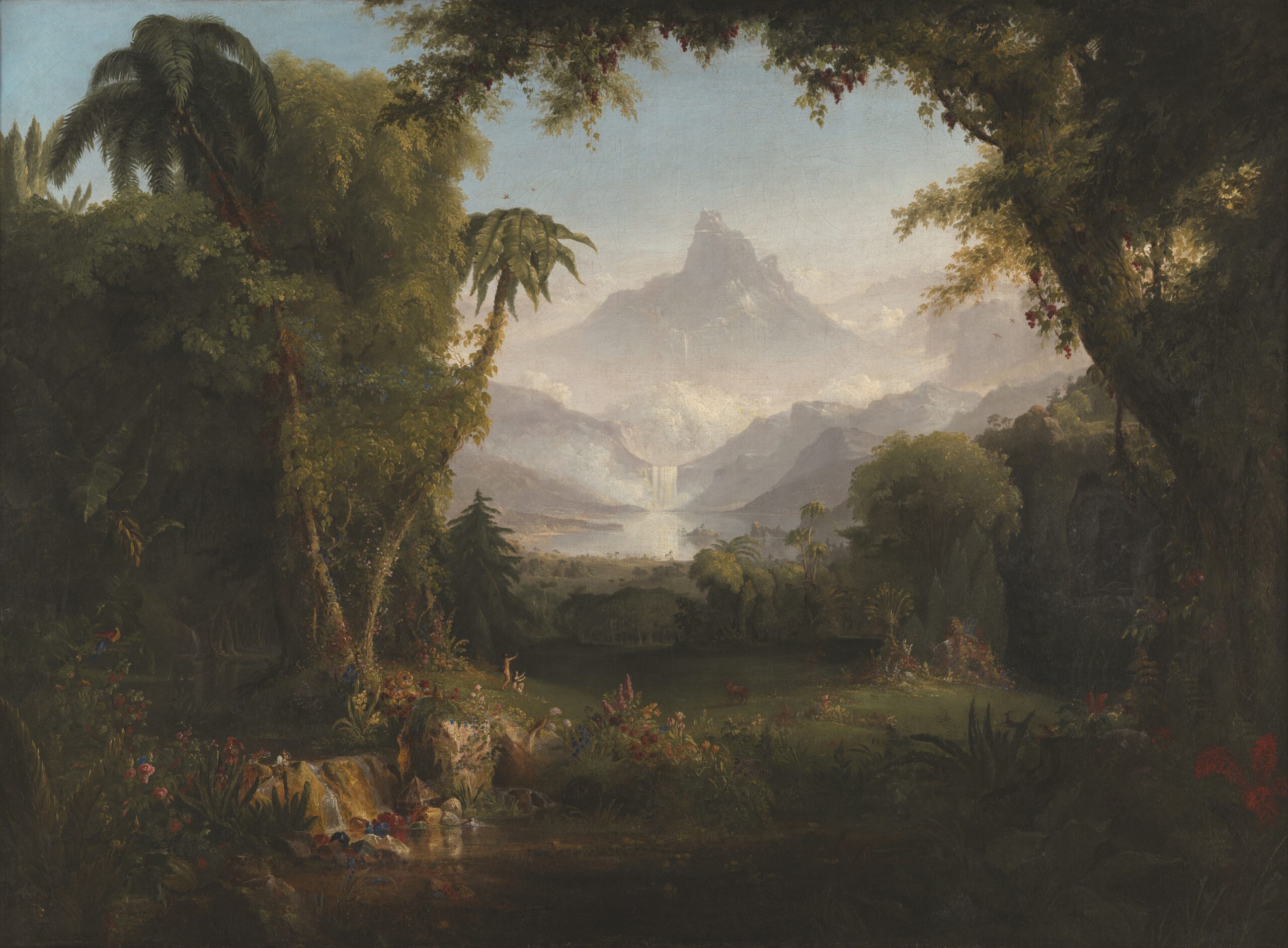
Genesis 2:4-17
Back before my wife and I had kids, we had a chance to visit Ireland. One of the things that always stuck with me was the signposts at the roundabouts, where the direction to each town was indicated by its own sign. I was trying to shift with my left hand and remember to go left into the roundabout instead of right, while my lovely bride would be reading as fast as she could through the stack of twenty or so signs for whatever town we were looking for. As we continue in this series of the creation narrative of Genesis, it feels like we’re looking at one of those Irish signposts with an overwhelming series of arrows, where resin points to bread, or a stone points to a priest. But just as all roads once led to Rome, the most important element in this passage is how all of it is pointing to Jesus.
Generations
We have worked our way through the 7 days of creation and seen so much about God’s sovereignty, wisdom, and goodness. God made everything, it was very good, and then God rested. But now, Moses is rewinding and zooming in to show us new information about those seven days, especially day six and the creation of Adam.
Our text opens with the generations of the heavens and the earth. We find more of these generations passages, sometimes called the toledot passages, in chapters 5&6, 10&11, 25, and then 36&37. Derek Kidner points out how these “generations” passages always have an element of pointing forward as it introduces a new stage of history. They’re kind of like chapter headings. What’s fascinating here is the contrast. The later passages are about the generations of Adam, Noah, Jacob, and so on. Here, we’re looking at all of creation as coming from God.
It is in this context that we’re first introduced to the name of God, YHWH, in conjunction with that term for God from ch. 1, Elohim, that hints at the Trinity. As many a theologian has observed, this is very intentional. In ch. 1, we’re looking at the transcendence of God in His glorious authority speaking creation into existence, but now the text is emphasizing the immanence of God, His condescension to His creation. It’s putting us on a “first-name basis” with God.
This second account of creation isn’t contradicting the first one, but rather giving us a different angle of the same event. God does this a few times in our Bible, like Kings and Chronicles, or the four gospels. So we need to remember that God is still speaking things into existence with ease, but Gen. 2 shows that it is still done with care and precision.
And here we have a new use of the word “day,” referring to the period of time when God was creating, rather than a single evening and morning. But that being said, there’s two possible time frames for the events of our text. Option one is that we’re going over days 3-6. So God makes all the plants, including the garden of Eden with a misting system on day 3, and then we jump forward to day 6 where Adam is made. For example, John Gill sees vv. 5-6 as a flashback to day 3, and the reason it’s a mist instead of rain is because the sun hasn’t been made yet to produce the rain cycle.
Option two is that this is all day 6. There were plants made back on day 3, but God left part of the earth barren so that He can plant this specific garden. I lean this direction, but either one works. The point here isn’t the sequence of what God made, but what God was making.
Eden
God planted a garden in Eden in the East. The names here are meaningful. The word Eden means “pleasant” or “delight,” and the word for garden in the Greek version is where we get the word “paradise” from. So the garden of Eden is the paradise of delight.
This divinely planned and planted garden is then watered by a river with 4 tributaries: Pishon, Gihon, Tigris, and Euphrates. Those last two may sound familiar to you, and there are theories that the first two, Pishon and Gihon, are actually names for the Nile in Egypt and the Ganges in India. In our text, Moses even describes their relative course in relation to Havilah and Cush, generally assumed to be Ethiopia. If you’re mental map of the middle east is fraying, you’re not alone. This text has spawned a lot of confusion, speculation, and debate. So what do we do with all this?
First, we want to recognize that Moses’ details here, confusing as they are, show us this is real history. Whatever the Pishon river and the land of Havilah were, there was really good gold there. And these rivers nourished the garden. This is one of those signposts that’s pointing us forward to multiple things. Ps. 46:4, “There is a river whose streams make glad the city of God, the holy habitation of the Most High.” Ps. 36:7-9, “How precious is your steadfast love, O God! The children of mankind take refuge in the shadow of your wings. They feast on the abundance of your house, and you give them drink from the river of your delights (Edens). For with you is the fountain of life; in your light do we see light.” Ez. 47:1-12 is part of a larger vision, but God shows Ezekiel this magnificent temple with rivers that actually transform saltwater into fresh. In Rev. 22:1, where the heavenly Jerusalem descends, John says, “Then the angel showed me the river of the water of life, bright as crystal, flowing from the throne of God and of the Lamb.”
But we have to remember that this is history of a different age, even from Moses. I was once asking a professor of mine questions about Eden and the trees, and he very graciously said it was a different world after the flood. And the Bible actually conveys this in 2 Pet. 3:5-7, “For they deliberately overlook this fact, that the heavens existed long ago, and the earth was formed out of water and through water by the word of God, and that by means of these the world that then existed was deluged with water and perished. But by the same word the heavens and earth that now exist are stored up for fire, being kept until the day of judgment and destruction of the ungodly.”
These descriptions also show us there were precious resources readily available: gold, bdellium, and onyx. Bdellium is an aromatic sap that was used in perfumes, incense, and even medicinal remedies, but Num. 11:7 compares it to Mannah. Onyx was a beautiful stone used in carvings and jewelry. Onyx stones were used in the construction of the tabernacle, most notably as the stones bearing the names of Israel for the ephod so that the priest could carry their names before the Lord. It was among the stones listed in description of the cryptic figure in Ez. 28:13 that some think is Satan and some think is Adam, and it in the foundations of the heavenly Jerusalem descending in Rev. 21:20. Gold, of course, is used in the tabernacle and temple, and the whole city of heavenly Jerusalem was made of this precious metal, even the pavement.
I know that’s a lot of puzzle pieces, but when we put them together, we find Eden to be a kind of natural, or at least divinely constructed, temple. The most precious thing about Eden wasn’t the climate, humidity, or room service. It was the presence of God. Eden was about God with humanity, heaven on earth. And that’s what we look for in the new creation. Rev. 21:3, “And I heard a loud voice from the throne saying, ‘Behold, the dwelling place of God is with man. He will dwell with them, and they will be his people, and God himself will be with them as their God.”
Trees
This garden was largely an orchard, it seems. God put every tree pleasing to the eye and good for food. He provided Adam with beautiful variety for both eye and tongue. But there were two trees in the middle of the garden that were set apart from the rest. The first we want to look at is the tree of life. God speaks of it as providing eternal life in Gen. 3:22, “Now, lest he reach out his hand and take also of the tree of life and eat, and live forever—” Kline claims that Adam was not initially permitted to partake of the tree of life until an appropriate future time when he had proven himself. Others have seen it as something Adam had to partake of continually. For example, Luther sees the tree of life as a kind of medicinal source whose fruit would prevent or cure aging, disease, and so on.
The tree itself seems to be gone from the earth after the flood, but its imagery is not. Prov. 3:18, says of wisdom, “She is a tree of life to those who lay hold of her; those who hold her fast are called blessed.” It was likely represented by the Menorah candlestick in the tabernacle and temple.
And of course, we see the tree return in a new heaven and a new earth. Rev. 2:7, Jesus said, “He who has an ear, let him hear what the Spirit says to the churches. To the one who conquers I will grant to eat of the tree of life, which is in the paradise of God.” Then in Rev. 22:1-3, “Then the angel showed me the river of the water of life, bright as crystal, flowing from the throne of God and of the Lamb through the middle of the street of the city; also, on either side of the river, the tree of life with its twelve kinds of fruit, yielding its fruit each month. The leaves of the tree were for the healing of the nations. No longer will there be anything accursed, but the throne of God and of the Lamb will be in it, and his servants will worship him.”
Then we see the tree of the knowledge of good and evil. There are quite a few theories on why God names it that, and they’re probably all right altogether. We can see that there was a kind of knowledge gained through eating it from Gen. 3:22, “Then the Lord God said, ‘Behold, the man has become like one of us in knowing good and evil…’” Motyer says, “The (fruit) was forbidden for human consumption because the wisdom acquired through eating it leads to independence from God, whereas true wisdom begins with ‘the fear of the LORD’ (Pr. 1:7).” And Ross writes, “This ‘knowledge’ was experiential. ‘Good and evil,’ a merism for the things that protect life and that destroy life, would be experienced if the forbidden fruit were eaten (v. 17).” Gill points out that by eating the tree, Adam came to know by experience both good and evil, whereas in the garden, he only would have experienced good.
But there’s another component we don’t want to miss here. The phrase “good and evil” was used for judgment. In 1 Ki. 3:9, Solomon prayed, “Give your servant therefore an understanding mind to govern your people, that I may discern between good and evil, for who is able to govern this your great people?” Kline claims that the name is representative of the choice Adam is faced with. To not eat is good; to eat is evil. To not eat of the tree and obey God would actually signify that Adam knew the difference between good and evil.
And again, we see this pointing forward to the tabernacle and temple. Beale writes, “The ark in the Holy of Holies, which contained the Law (which led to wisdom), echoes the tree of the knowledge of good and evil (which also led to wisdom). Both the touching of the ark and the partaking of the tree’s fruit resulted in death. The entrance to Eden was from the east… just as the entrance to the temple was from the east… Both Eden and the temple are characterized by the holy presence of God that brings wisdom.”
Together, these trees serve as a kind of sacrament for the temple-garden. Luther writes, “…this tree of the knowledge of good and evil was Adam’s church, altar, and pulpit. He was here to yield to God the obedience he owed, give recognition to the Word and will of God, give thanks to God, and call upon God for aid against temptation.”
The truly unique elements of these trees were the roles God assigned to them, like our communion bread and wine. Whether they were apples, pomegranates, almonds, or something unknown to us, it was God that made them holy. As Kidner said, “It does not make the trees magical (for the Old Testament has no room for blind forces, only for the acts of God), but rather sacramental, in the broad sense of the word, in that they are the physical means of a spiritual transaction.”
Adam
Outside of the Garden, God made man. Matthew Henry shows the importance of this: “He lived out of Eden before he lived in it, that he might see that all the comforts of his paradise-state were owing to God’s free grace. He could not plead a tenant-right to the garden, for he was not born upon the premises, nor had any thing but what he received; all boasting was hereby for ever excluded.”
God formed Adam from the dust into the image of God and put life into him. Man’s breath depends upon God’s action. Job 32:8, “But it is the spirit in man, the breath of the Almighty, that makes him understand.” Again, Moses is emphasizing care and design, but it also diminishes man’s intrinsic worth as a walking dirtball.
Man is formed from the ground. As Mangum points out, “The word for man is adam, while ground is adamah, so the verse says that God formed adam from the dust of adamah.” And the forming language gives us the vocabulary for the potter and his clay. Isa. 29:16, “You turn things upside down! Shall the potter be regarded as the clay, that the thing made should say of its maker, ‘He did not make me’; or the thing formed say of him who formed it, ‘He has no understanding’?” Jer. 18:3-6, “So I went down to the potter’s house, and there he was working at his wheel. And the vessel he was making of clay was spoiled in the potter’s hand, and he reworked it into another vessel, as it seemed good to the potter to do. Then the word of the Lord came to me: ‘O house of Israel, can I not do with you as this potter has done? declares the Lord. Behold, like the clay in the potter’s hand, so are you in my hand, O house of Israel.'” Rom. 9:20-23, “But who are you, O man, to answer back to God? Will what is molded say to its molder, ‘Why have you made me like this?’ Has the potter no right over the clay, to make out of the same lump one vessel for honorable use and another for dishonorable use? What if God, desiring to show his wrath and to make known his power, has endured with much patience vessels of wrath prepared for destruction, in order to make known the riches of his glory for vessels of mercy, which he has prepared beforehand for glory—”
But why does it say dust instead of clay? To show the impossible nature of what God is doing and sustaining. Who can sculpt dust and hold it together even without making it a living thing? Only God can do this, and when God lets us go, we cannot hold ourselves together. Ecc. 3:20, “All go to one place. All are from the dust, and to dust all return.” As Matthew Henry said, “The workmanship exceeded the materials.”
God placed Adam into this garden where he had all he could possibly need. It was never more true than in Eden what Solomon wrote in Ecc. 3:11-13, “He has made everything beautiful in its time. Also, he has put eternity into man’s heart, yet so that he cannot find out what God has done from the beginning to the end. I perceived that there is nothing better for them than to be joyful and to do good as long as they live; also that everyone should eat and drink and take pleasure in all his toil—this is God’s gift to man.”
God put Adam into the temple-garden-paradise to work and keep it. It was work, but it wasn’t sorrowful, sweaty toil. As Calvin said, “…men were created to employ themselves in some work, and not to lie down in inactivity and idleness. This labour, truly, was pleasant, and full of delight, entirely exempt from all trouble and weariness; since, however, God ordained that man should be exercised in the culture of the ground, he condemned, in his person, all indolent repose.”
But even this was temple-work as much as gardening. Beale points out that Num. 18:5-6 uses these same words to instruct the priests to “do the work” of the tabernacle and “keep” the sanctuary. While Gen. 1 emphasized for us how Adam was set as a king over creation to exercise dominion, Gen. 2 is showing Adam as a priest in the garden-temple for the worship of God. God is even making Adam a prophet by giving him law that he must later convey to another.
Adam is commanded to work and keep, but also to not eat of the tree of knowledge. If he does, God tells him, he will surely die. This is more than Adam becoming mortal. As the venerable Bede said, “Indeed, man died in his soul when he sinned, because God, who is the life of the soul, withdrew from him. The death of the body rightly follows the death of the soul, when the soul, which is his life, departs from him. Death came, then, to that first man when he came to the end of the present life a long time after he ate that which was forbidden.”
Arthur W. Pink once said that as physical death is the separation of the soul from the body, spiritual death is the separation of the soul from God. God is speaking here of the spiritual death, but that would lead to physical death as well. For Adam to eat the fruit is to set himself and all his descendants on a course to hell.
This life of the blessed priest-king was lost when Adam sinned. Yet God would restore pieces of it for His people. He gave them priests, and in a sense, made them all priests. Ex. 19:6, God said, “‘and you shall be to me a kingdom of priests and a holy nation.’ These are the words that you shall speak to the people of Israel.” And this is even more true for the church today. 1 Pet. 2:5, “you yourselves like living stones are being built up as a spiritual house, to be a holy priesthood, to offer spiritual sacrifices acceptable to God through Jesus Christ.”
Second Adam
So we’ve seen a lot of signposts and connections here. The garden is connected to the tabernacle, temple, church, heaven, and new creation. The tree of life is connected to the menorah and new creation. The tree of knowledge connects to the ark. But more important than all these, all of them connect and point to Jesus Christ as God in flesh. Even as God breathes life into Adam, we are pointed to John 20:22, “And when (Jesus) had said this, he breathed on them and said to them, ‘Receive the Holy Spirit.’” The onyx stones with the names of Israel is a type and shadow of how Christ would carry the names of the elect upon His heart as He went to the cross for us.
Augustine and Eucharius see the tree of life as a symbol of Christ, and it is only by eating of Christ that we can have eternal life. John 6:53-54, “So Jesus said to them, ‘Truly, truly, I say to you, unless you eat the flesh of the Son of Man and drink his blood, you have no life in you. Whoever feeds on my flesh and drinks my blood has eternal life, and I will raise him up on the last day.’”
Pink makes a series of contrasts between the tree of knowledge in the garden and the tree upon which Christ was crucified. The first was pleasant to the eyes, but the second was “hideous and repellant.” God forbade man to eat of the first tree, but we are called and commanded to eat of the second and see that the Lord is good. We might add that Paul warned the Corinthians that to partake of the table without faith is to eat judgment and death instead of life. Satan used all his wiles to convince man to eat of the first, but pulls out all the stops to prevent men from eating of the second. The first was a living tree that brought death, but the second was a dead tree that brings life. Finally, the first tree led to our exile from paradise, yet the second tree is the means by which we can return to paradise. In Luke 23:43, when the thief on the cross beside Christ spoke in faith, “And he said to him, ‘Truly, I say to you, today you will be with me in paradise.’’
Paul called Jesus the second or last Adam. 1 Cor. 15:45-47, “Thus it is written, ‘The first man Adam became a living being’; the last Adam became a life-giving spirit. But it is not the spiritual that is first but the natural, and then the spiritual. The first man was from the earth, a man of dust; the second man is from heaven.” Jesus was everything Adam should have been as prophet, priest, and king. Satan tempted Adam in the beauty and sufficiency of the garden, but Adam failed. Satan tempted Jesus in the stark desperation of the wilderness, but Christ succeeded.
Perhaps the most fascinating comparison here is between Jesus and the tree of knowledge. The tree was the embodiment of judgment; eating was condemnation while refraining was confirmation. We find it was the same, just inverted, with Jesus. To reach out, to lay hold of Christ, and to eat was to be saved, to know the greatest good. John 3:17-18, “For God did not send his Son into the world to condemn the world, but in order that the world might be saved through him. Whoever believes in him is not condemned, but whoever does not believe is condemned already, because he has not believed in the name of the only Son of God.”
If you don’t get anything else, make sure you get this. Jesus is everything good, everything we need, and the only way we can get to a paradise greater than Eden. Adam had every advantage and yet he failed. We’ve all made it worse every time we broke God’s law: every lie, every theft, every prideful thought. But Jesus got a perfect score in life, then took the punishment for the sins of His people. If we run to Him in repentance and faith, we will be saved, and at the end of this world, we’ll have a place in the paradise of delight.

Chris J. Marley is the pastor of Miller Valley Baptist Church in Prescott, AZ. Chris has a BA in Theatre, an MDiv from Westminster Seminary California, and a certificate from the Institute of Reformed Baptist Studies. He is the author of Scarlet and White and Cow and Cog.